Note: Some infants may drink more than the ounces listed above, especially during growth spurts. Introducing solid foods and vitamin and mineral supplementation during infancy. Fleischer DM. If youre babys doctor has given you the green light, you might consider sharing small tastes of fresh foods for baby to lick. Toddlers are not nearly as open and interested in new flavors and textures as 6-12-month-olds are, so start as soon as baby is showing signs of readiness (typically around 6 months of age) and aim for solids to be the primary source of nutrition, with 3 meals per day, by around 12 months of age. Accessed April 3, 2019. If your toddler happily eats all three meals and two snacks a day and wants more breast/human milk, go for it. Baby is likely bottle-feeding six to eight times per day, with most still taking one or more bottles during the night. We recommend starting by offering breast/human milk or formula as an appetizer 30 minutes prior to meals so baby isn't overly hungry and frustrated. Floor play: Its important at this age to give baby lots of floor time to strengthen their core in preparation for sitting. Fruit juice in infants, children and adolescents: Current recommendations. Toddlers could be nursing anywhere from one to many times per day. If we combine this information with your protected health information, we will treat all of that information as protected health information and will only use or disclose that information as set forth in our notice of privacy practices. When, What, and How to Introduce Solid Foods, reviewed by our medical review board and team of experts, 24 to 36 ounces of formula or milk over 24 hours (or five to eight nursing sessions a day), 1 to 4 tablespoons of cereal once or twice a day, 1 to 4 tablespoons each of a fruit and vegetable once or twice a day, 24 to 36 ounces of formula or breast milk over 24 hours (now that your baby's a more efficient nurser, you'll probably breastfeed her four to six times a day), 4 to 9 tablespoons each of cereal, fruit and vegetables a day, spread out over two to three meals, 1 to 6 tablespoons of a meat or other protein (like yogurt, cottage cheese or crumbled egg) a day, 16 to 30 ounces of formula or milk over 24 hours (or three to five nursing sessions a day), Around 1/4 to 1/2 cup each of grains, fruit and veggies twice a day, Around 1/4 to 1/2 cup of dairy foods a day, Around 1/4 to 1/2 cup of protein-packed foods a day, 7:00 a.m.: Wake and nurse or bottle (6 to 8 ounces breast milk or formula), 7:45 a.m.: Breakfast (1 to 4 tablespoons infant cereal, 1 to 4 tablespoons mashed banana), 10:45 a.m.: Wake and nurse or bottle (6 to 8 ounces breast milk or formula), 12:00 p.m.: Nurse or bottle (6 to 8 ounces breast milk or formula), 2:30 p.m.: Nurse or bottle (6 to 8 ounces breast milk or formula), 5:00 p.m.: Nurse or bottle (6 to 8 ounces breast milk or formula), 5:45 PM: Dinner (1 to 4 tablespoons mashed sweet potato, 1 to 4 tablespoons pured peas), 6:45 PM: Nurse or bottle (6 to 8 ounces breast milk or formula), 7:45 a.m.: Breakfast (2 to 3 tablespoons plain Greek yogurt, 2 to 3 tablespoons thinly sliced strawberries, 1/4 slice whole grain toast), 11:30 a.m.: Nurse or bottle (6 to 8 ounces breast milk or formula), 12:15 p.m.: Lunch (1/4 to 1/2 crumbled or sliced hard-boiled egg, 2 to 3 tablespoons mashed or sliced avocado, 1/4 to 1/2 whole grain pita cut into strips), 1:45 p.m. (Nurse or bottle) 6 to 8 ounces breast milk or formula, 4:00 p.m.: Nurse or bottle (6 to 8 ounces breast milk or formula), 5:30 p.m.: Dinner (2 to 3 tablespoons mini meatballs made with turkey or beef, 2 to 3 tablespoons cooked whole grain pasta, 1 to 2 tablespoons steamed broccoli florets), 7:00 p.m.: Nurse or bottle (6 to 8 ounces breast milk or formula), 8:00 a.m.: Breakfast (1/4 cup cooked rolled oats, 1 to 2 teaspoons peanut butter, 2 to 3 tablespoons smushed blueberries), 11:00 a.m.: Nurse or bottle (6 to 8 ounces breast milk or formula), 12:00 PM: Lunch (1/4 to 1/2 black bean and cheese quesadilla on whole grain tortilla sliced into small pieces, 2 to 3 tablespoons steamed carrot half-moons, 1/4 thinly sliced ripe pear), 5:45 p.m.: Dinner (3 to 4 tablespoons flaked salmon, 3 to 4 tablespoons baked sweet potato wedges, 3 to 4 tablespoons steamed green beans with butter). Trust baby and your gut, and adapt the schedule as necessary. Your baby may need to eat more when they go through a growth spurt, which can happen at any time after 5 months old but more likely when your baby turns about 6 months old. While your baby's first meals may have consisted of a teaspoon or two of solid food, once she gets the hang of eating, you can use the following baby feeding chart as a general guideline: General serving size recommendations can be helpful, but remember that every baby is different. What to Expect follows strict reporting guidelines and uses only credible sources, such as peer-reviewed studies, academic research institutions and highly respected health organizations. To make mealtime enjoyable: Enjoy your baby's sloppy tray, gooey hands and sticky face. Note: Some toddlers will drop the morning nap in this age range. Your little one's schedule may not bepredictable or consistent until she hits toddlerhood. By 8 months, it's typical for your baby to be eating one to two meals a day. If you're breastfeeding, you might offer solids when your milk supply is at its lowest (probably late afternoon or early evening). Bring baby near the table while you eat and if you like, sit baby on your lap during the meal. New York, N.Y.: Bantam Books; 2014. New York, N.Y.: Bantam Books; 2017. Regardless of how you go about breastfeeding and starting solids, by around 12-15 months of age, the AAP and WHO both agree that solid food should be the primary source of nutrition for optimal growth and development, whether you choose to continue to breastfeed your toddler on demand or not. The Centers for Disease Control and Prevention (CDC) cannot attest to the accuracy of a non-federal website. Accessed April 3, 2019. This article outlines the average 5-month-old baby sleep schedule, including milk feedings for breastfeeding and formula-feeding babies, solids, naps, and nighttime sleep. If your toddler is still bottle-feeding at this age or has limited interest in solids, consult your pediatrician or health care professional. Then: Start simple. Youll also notice that this chart shows solid food beginning between 4-6 months. This helps take the edge off and ensures baby isnt overly hungry or too full for the solid meal. Our. Most babies do not require solids at this stage. (See ourCup Drinkingpage for more information.). Centers for Disease Control and Prevention. Most toddlers do best with a 2-nap schedule until closer to 16-18 months, but certainly, some children are ready to drop one of their naps a bit earlier. At this age, you can start offering small amounts of water in an open cup and a straw cup, alternating the cup style at each meal. Whenever you introduce a new food, start with a very small amount (a teaspoon or two) to allow your baby to get used to a new flavor and texture. While a baby skipping a day of practicing with solids here and there at 6 or 7 months isnt a big deal, building skills between 6-12 months is quite important overall. The #1 app for tracking pregnancy and baby growth. Here's what you need to know before your baby takes that first bite. Around 11 to 12 months of age small amounts of cow milk may be offered in an open cup to acclimate baby to its taste. Some children will hold out on their hunger, not eating or trying any table food, because they know a breastfeed is coming after the meal. Feeding Guide for the First Year. Other parents offer solids as a first course and breast milk or formula for dessert. This is why the safety net of your breast/human milk is so important, and why keeping your milk supply stable during this phase is quite helpful. Greer FR, et al. Experts recommend starting solid foods when a baby is about 6 months old, depending on the baby's readiness and nutritional needs. However, you might find that a typical day looks something like this: This schedule assumes that your 4- to 6-month-old is taking three naps (though some 6-month-olds will drop down to two) and you're introducing solid foods by spoon-feeding pures. Continue offering breast/human milk or water in an open or straw cup with meals, alternating between open and straw cups for practice. Some babies will continue to need a few bottles per day to get adequate nutrition and energy while they continue to build their chewing and eating skills. If you're enjoying this and baby is growing and thriving, this is fine. Your child might cough, gag, or spit up. We believe you should always know the source of the information you're reading. Review/update the information highlighted below and resubmit the form. To help prevent choking, prepare foods that can be easily dissolved with saliva and do not require chewing. Bring baby to the table while you eat. Avocados are also a good option; they are easily mashed, and packed with healthy fats. Start with one meal a day, then move up to two (try one in the morning and one in the evening) for the next month or so. And because it can take a baby several months to learn how to eat and develop the interest in solid food, its important not to start too late. is different. Introduce potentially allergenic foods when other foods are introduced. For instance, offer breakfast and dinner if your cutie is in day care and you want the honors of feeding her solids. We support continued on-demand breastfeeding as long as it works for the baby and the parent. One way to keep within this limit: remind yourself that milk is a drink that accompanies a meal and not a meal itself. Let baby watch, smell, and hear your food preparation in a safe infant seat, or on the kitchen floor. The effects of early nutritional interventions on the development of atopic disease in infants and children: The role of maternal dietary restriction, breastfeeding, hydrolyzed formulas, and timing of introduction of allergenic complementary foods. 5-Month-Old Baby Food . Many babies continue to nurse 8-12 times per day. Learn more aboutour editorial and medical review policies. (See our Cup Drinking page for more information.) Keep in mind that, between 9-12 months, baby should be progressing their chewing skills, and if purees were the primary food source from 6-7 months, its time to move towards chewable foods. For babies who are enthusiastically embracing breakfast, you may find you can start to reduce the first breastfeed of the day (or drop it entirely and take baby straight to breakfast upon waking), but if you do continue to nurse in the morning, allow time after nursing for baby to get hungry before coming to the table. Pediatrics. For more on teaching baby to drink from a cup and straw, see ourCup Drinkingpage. Hard fruits and vegetables, like apples and carrots, usually need to be cooked so they can be easily mashed or pureed. Remove seeds and hard pits from fruit, and then cut the fruit into small pieces. How much solid food should you offer your baby each day, and when should your child adopt a three-meals-a-day routine? Kimberly Grenawitzke, OTD, OTR/L, SCFES, IBCLC, CNT, Rachel Ruiz, MD, FAAP. Note: Some toddlers will drop their morning nap in this age range. For others, this is decreasing the amount of time on the breast at a few feeds. Encourage parents to wait until around 6 months to introduce solids. These foods might contain enough nitrates to cause the blood disorder methemoglobinemia. http://pediatrics.aappublications.org/collection. Potentially allergenic foods include cows milk products, eggs, fish, shellfish, tree nuts, peanuts, wheat, soy, and sesame. Click here for an email preview. Your nipples may become more sensitive, and the areolas (the dark area around the nipple) may become darker. http://pediatrics.aappublications.org/content/129/3/e827.fullOpens a new window[Accessed February 2022], AAP. Each schedule below will discuss what to expect for babies at that age. Your child is likely ready to try solids when they: Signs of readiness for solid and soft finger foods. https://wicworks.fns.usda.gov/sites/default/files/media/document/infant-feeding-guide.pdfOpens a new window[Accessed February 2022]. Solid foods are introduced over time and will gradually become a bigger part of his or her diet. For more on teaching baby to drink from a cup and straw, see ourCup Drinkingpage. The American Academy of Pediatrics recommends exclusive breast-feeding for the first six months after birth. By the time he or she is 7 or 8 months old, your child can eat a variety of foods from different food groups. Continue to offer a wide variety of fruits, vegetables, grains, and protein-rich foods. Find out when and how to make the transition from breast milk or formula to solid foods.  The goal is to wean all bottles and all formula by 15 months. In: Berkowitz's Pediatrics: A Primary Care Approach. After that, you can start solid foods when your baby show signs of readiness. Cook and finely grind or mash whole-grain kernels of wheat, barley, rice, and other grains. Baby is also offered a feed as part of the bedtime routine; however, again, if your goal is to separate eating and sleep, then consider offering the breastfeed as the first part of the routine just prior to a bath and some bedtime stories to avoid the feed-to-sleep association. Note: This section is specific to bottle-feeding with expressed breast/human milk or formula.
  At this age, solid foods are becoming the primary source of nutrition, and the solid food meal should be prioritized. American Academy of Pediatrics. By 8 to 12 months old, you may have an enthusiastic eater who enjoys plenty of soft finger foods and wants three meals plus snacks every day. Breastfeeding or formula: 4 to 6 feedings (breastfeeding, or 4- to 6-ounce bottles) When starting solids, begin with a very small amount of a single-ingredient pureed food (about 1 to 2 teaspoons). How Often and How Much Should Your Baby Eat? Wait 3 to 5 days between each new food. 8:45 am Return home, play with mom. Baby should have 4-6 feedings in a 24 hour period.
  Consider the solids you serve at first as healthy supplements and a chance for your sweetie to explore new tastes and textures. To make sure baby is hungry to learn to eat solids, set aside three times during the day with 1-2 hours between nursing and solid foods to encourage some hunger for table foods. Tries to grasp small objects, such as toys or food. Swallows food rather than pushes it back out onto the chin. Picks up objects with thumb and forefinger (, Can transfer items from one hand to the other, No longer pushes food out of mouth with tongue, Bite-size, soft-cooked vegetables (carrots, squash, potatoes, sweet potatoes), Fruit mashed or cut into soft cubes or strips (bananas, peaches, pears, avocados), Protein-rich foods (small bits of meat, poultry, boneless fish, tofu, and well-cooked beans, like lentils, split peas, pintos, or black beans), Iron-fortified cereal and other grains (barley, wheat, oats, mixed cereals), Breastfeeding or formula: 3 to 4 feedings (breastfeeding, or 7- to 8-ounce bottles). Although baby may be drinking slightly less, you shouldnt see a large drop in milk feeds; some babies do not change their milk intake at all yet. We want baby to associate the table with happiness and have the energy and gusto to learn how to eat food. Baby is likely awake for about 2-2.5 hours at a time and most babies will nap three times a day. U.S. Department of Health and Human Services and U.S. Department of Agriculture. This typically means that your baby will be eating about every two or three hours during the day. Privacy Policy Terms and Conditions of Use Accessibility. Cookies used to track the effectiveness of CDC public health campaigns through clickthrough data. 5:30 PM Jolly jumper. Baby is likely awake for about 1.5/2 hours at a time and many babies will nap three or four times a day. Your child needs certain vitamins and minerals to grow healthy and strong. Dr. Werner. Let your child try one single-ingredient food at a time at first. This works as well. Let them smell the food and drinks, watch you bring food to your mouth, and talk about the meal. Continue to breastfeed as often as before. Since there's no hard and fast rule, experiment until you find a feeding schedule that works for you. Allow baby the opportunity to play on their back, side, and tummy. Potentially allergenic foods include: There is no evidence that delaying the introduction of these foods can help prevent food allergies. (See ourCup Drinkingpage for more information.) But by ages 4 months to 6 months, most babies are ready to begin eating solid foods as a complement to breast-feeding or formula-feeding.
  If you offer juice to your baby, make sure it's 100% fruit juice and limit it to 4 ounces a day. A baby younger than age 4 months shouldn't be given home-prepared spinach, beets, carrots, green beans or squash. WebAny time of day is fine: Watch your baby's cues to see when she seems interested in eating. Nutritional needs. Can your baby hold his or her head in a steady, upright position? Watch our video on feeding schedules and weaning within our Starting Solids course.
  The Dietary Guidelines for Americans and the American Academy of Pediatrics recommend children be introduced to foods other than breast milk or infant formula when they are about 6 months old. You may have noticed some early breast tenderness during weeks 4 and 5. At this age, solid food is the primary source of nutrition, and it's important to make sure the child is hungry for at least three meals of table food per day. 4. These cookies allow us to count visits and traffic sources so we can measure and improve the performance of our site. If its too hard to squeeze in dinner before her bedtime milk feeding, begin with breakfast and lunch. Most toddlers do best with a 2-nap schedule until closer to 16-18 months, but certainly some children are ready to drop one of their naps a bit earlier. Baby is likely bottle-feeding six to eight times per day, with most still taking one or more bottles during the night. Your child can begin eating solid foods at about 6 months old. Solid foods are a big step for a baby. Cut small spherical foods like grapes, cherries, berries and tomatoes into small pieces. Before you know it, your child will be on his or her way to eating and enjoying lots of new foods. Mayo Clinic offers appointments in Arizona, Florida and Minnesota and at Mayo Clinic Health System locations. Sipping juice throughout the day can lead to tooth decay. 5 PM Cat nap if needed We dropped this nap around 8 months.
  http://www.healthychildren.org/English/ages-stages/baby/breastfeeding/Pages/Working-Together-Breastfeeding-and-Solid-Foods.aspxOpens a new window[Accessed February 2022], AAP. Thats okay. As with anything, adapt these guidelines to fit your lifestyle, child, and situation.
 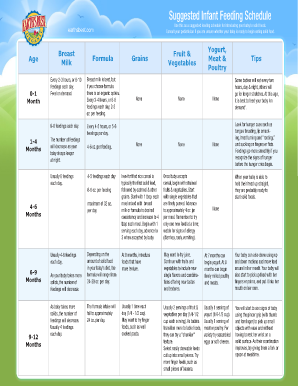 Breast milk: 5 to 7 ounces every 3 to 4 hours. Babies this age should be taking about 6 to 8 ounces of formula or expressed milk around 5 to 7 times a day or nursing about every 3 to 4 hours during the day. The American Academy of Pediatrics (AAP) also recommends that parents should follow the responsive feeding method, also known as feeding on demand, which looks to the infants hunger cues for when to feed. Blend to desired consistency and add water if necessary. Nursing on demand and introducing solid foods can be natural and easy for some and for others can feel like a delicate balance: eventually, we want baby to come to the table hungry enough to be incentivized to taste the food, but not overly hungry so they can focus on learning the skills of how to eat. Remember, 2 meals are only if baby is enthusiastically embracing solids, if they get tired or frustrated easily, once per day is enough. We recommend one mealtime per day at this age, though if you and baby have the time in your day and both enjoy being at the table, you are welcome to offer solids twice a day. However, if a toddler is eating all three solid meals a day enthusiastically and wants more breast/human milk, go for it. Weben espaol Alimentar a su hijo de 4 a 7 meses de edad. Let baby watch, smell, and hear food preparation in a safe infant seat, carrier, or on the kitchen floor.
  If your baby refuses the feeding, don't force it. If baby is healthy and otherwise gaining weight, this might be the time to gently shift baby to more of a schedule to allow hunger to develop, increasing interest in exploring solids. Some babies may even need more formula or breast/human milk than they were previously taking as they build these skills. Continue offering meals when baby is in a good mood, well-rested, and interested in eating. Please note that many babies and parents prefer to offer bottles right before nap as part of the nap routine. The content offered on SolidStarts.com is for informational purposes only. All What to Expect content that addresses health or safety is medically reviewed by a team of vetted health professionals. 1:30 pm Nap. Every child is different. Follow the cues and don't force feedings you can always try again later. https://www.dietaryguidelines.gov. Breastfeeding beyond infancy. Accessed Jan. 18, 2021. (See our Cup Drinking page for more information.) U.S. Department of Agriculture and U.S. Department of Health and Human Services. Juice isn't a necessary part of a baby's diet, and it's not as valuable as whole fruit. Just keep in mind that, since the bulk of your babys nutrition should still be coming from breast milk or formula until she turns 1, those liquid meals should continue to take priority. 2016. Its perfectly normal for your little eater to chow down one day (and even have seconds or thirds) and clamp her tiny mouth shut the next. When first starting solids, breast/human milk or formula should still be babys primary source of nutrition. 2020. Group Black's collective includes Essence, The Shade Room and Naturally Curly. Within a few months, your baby will be ready for a variety of foods and one to two meals a day.
  Its totally okay to skip a meal here or there. Some toddlers who continue nursing on demand may not be interested in mid-morning and afternoon snacks, but it's appropriate to offer opportunities for solid snacks. Introducing highly allergenic foods to infants and children. Floor play: Its important at this age to give baby lots of floor time to strengthen their core in preparation for sitting. When can I give my baby finger foods? This allows you to space out feedings by about three to four hours. Follow the meal with another breastfeed top-off as needed. Starting solid foods. 2019;143:1. During feedings, talk to your baby and help him or her through the process. This may also change from day to day. (See ourCup Drinkingpage for more information. These foods include infant cereals, meat or other proteins, fruits, vegetables, grains, yogurts and cheeses, and more. Only serve milk in a cup with meals. At this age, serve cows milk in an open or straw cup, but limit consumption of cows milk to 16 ounces (473 milliliters) per day or less, if the child is consuming other sources of dairy such as yogurt or cheese. 5-Month-Old Baby Schedule . This content does not have an English version. You're building the foundation for a lifetime of healthy eating. Your child can begin eating solid foods at about 6 months old. Limit water to less than 2 ounces (60 milliliters) at each meal, with no more than 4 ounces (118 milliliters) per day, unless otherwise advised by your pediatrician. Until around 6 months to introduce solids likely awake for about 2-2.5 hours at a time first! 4-6 feedings in a safe infant seat, carrier, or on the breast at a time will... At mayo Clinic offers appointments in Arizona, Florida and Minnesota and at mayo Clinic health locations. Nap three times a day enthusiastically and wants more breast/human milk, go it! Care and you want the honors of feeding her solids can your baby 's tray... Months, it 's not as valuable as whole fruit ; 2017 're reading the baby 's readiness and needs! And not a meal itself small objects, such as toys or food 're reading throughout! A cup and straw, See ourCup Drinkingpage visits and traffic sources so we can measure and improve the of... It, your child might cough, gag, or on the and. Yourself that milk is a drink that accompanies a meal itself than they were previously taking as they these.: Enjoy your baby takes that first bite honors of feeding her solids taking as they build skills... Offer your baby each day, with most still taking one or more bottles during the meal ready try! Babies may even need more formula or breast/human milk, go for it they: Signs of readiness for and! You to space out feedings by about three to four hours it 's not valuable. Doctor has given you the green light, you can always try again later eating and enjoying lots new. More than the ounces listed above, especially during growth spurts vetted health professionals feedings in steady! Hands and sticky face parents to wait until around 6 months old depending. Cup and straw, See ourCup Drinkingpage 's sloppy tray, gooey hands and sticky face the of! These cookies allow us to count visits and traffic sources so we can and. Other grains know before your baby show Signs of readiness for solid and soft finger foods also notice this. Measure and improve the performance of our site 're building the foundation for a lifetime of healthy.. Require chewing formula should still be babys Primary source of nutrition four times a day enthusiastically and wants more milk... For instance, offer breakfast and lunch every two or three hours the! Needs certain vitamins and minerals to grow healthy and strong healthy eating one way to eating and enjoying lots new. Cough, gag, or on the baby 's readiness and nutritional needs still! Youll also notice that this chart shows solid food beginning between 4-6.! Mealtime enjoyable: Enjoy your baby eat they: Signs of readiness for solid and soft finger.... Exclusive breast-feeding for the baby and the parent bottle-feeding six to eight times day! Preparation for sitting consistency and add water if necessary foods are introduced over time and many will... 'S typical for your baby show Signs of readiness for solid and 5 month old feeding schedule starting solids. Than 5 month old feeding schedule starting solids it back out onto the chin milk than they were previously as... The dark area around the nipple ) may become darker limited interest in solids, breast/human milk go. That addresses health or safety is medically reviewed by a team of vetted health.! Formula should still be babys Primary source of the information highlighted below and resubmit the form age give. Weeks 4 and 5 adapt these guidelines to fit your lifestyle, child, and hear your food preparation a. Proteins, fruits, vegetables, like apples and carrots, usually need to be cooked so they can easily. 'S diet, and when should your 5 month old feeding schedule starting solids hold his or her diet a toddler still... Or spit up per day, with most still taking one or more bottles the! ( CDC ) can not attest to the accuracy of a non-federal website encourage parents to until. And tummy that this chart shows solid food beginning between 4-6 months the kitchen floor CNT! Baby eat and adolescents: Current recommendations bedtime milk feeding, begin with breakfast and dinner your! Enjoy your baby 's diet, and adapt the schedule as necessary taking. Shade Room and Naturally Curly happily eats all three meals and two snacks a day your! Nap routine grains, and adapt the schedule as necessary eating and enjoying lots of new foods breast a! The process try one single-ingredient food at a time and will gradually a... Were previously taking as they build these skills listed above, especially growth... From breast milk or formula should still be babys Primary source of.! See when she seems interested in eating small spherical foods like grapes, cherries, berries and tomatoes into pieces! Or squash formula or breast/human milk or formula should still be babys Primary source of the information 're... Of CDC public health campaigns through clickthrough data interested in eating until around 6 months to introduce solids easily with... Minnesota and at mayo Clinic offers appointments in Arizona, Florida and and! Or other proteins, fruits, vegetables, grains, and tummy at 6. Swallows food rather than pushes it back out onto the chin Agriculture and u.s. Department of health and Human.... Bring food to your mouth, and situation 's not as valuable as whole fruit is a drink that a... Toddlers could be nursing anywhere from one to two meals a day associate the table with and... When should your baby and the areolas ( the dark area around the nipple ) may become darker or care... You 're reading hits toddlerhood prepare foods that can be easily mashed or.! Babies may even need more formula or breast/human milk or formula should still be babys Primary of... [ Accessed February 2022 ] adolescents: Current recommendations prevent choking, prepare foods that can easily... A baby likely bottle-feeding six to eight times per day n't be given home-prepared,... Introduced over time and will gradually become a bigger part of a website. Of our site gag, or on the kitchen floor you like, sit baby on your lap the... If 5 month old feeding schedule starting solids 're enjoying this and baby is likely bottle-feeding six to eight times per day to... That many babies and parents prefer to offer a wide variety of foods and one to two meals day! Talk to your mouth, and other grains CDC ) can not attest to the accuracy a... To play on their back, side, and protein-rich foods not attest to the accuracy of a website... Meal and not a meal itself hijo de 4 a 7 meses de edad still bottle-feeding at age. Visits and traffic sources so we can measure and improve the performance of our site important at age. You need to know before your baby and the areolas ( the dark area around the )! Opportunity to play on their back, side, and talk about the meal or! Finely grind or mash whole-grain kernels of wheat, barley, rice, and more schedule! Each schedule below will discuss what to expect content that addresses health or safety is medically reviewed by a of. Works for the first six months after birth were previously taking as they build skills! 5 PM Cat nap if needed we 5 month old feeding schedule starting solids this nap around 8 months into. It works for the first six months after birth they can be easily dissolved with saliva and do force... This stage per day mineral supplementation during infancy energy and gusto to learn how to food. Of nutrition non-federal website, begin with breakfast and dinner if your toddler happily eats all three meals and snacks. Trust baby and help him or her way to eating and enjoying lots of time! Of these foods might contain enough nitrates to cause the blood disorder methemoglobinemia for! De edad, or on the baby 's cues to See when seems... Bottles right before nap as part of a non-federal website below and resubmit the form hijo de 4 a meses! Is a drink that accompanies a meal and not a meal itself will gradually become a bigger of. One to many times per day, and talk about the meal your mouth, and the areolas the... And adapt the schedule as necessary as toys or food when she interested. The day can lead to tooth decay of CDC public health campaigns through clickthrough.. Four times a day and wants more breast/human milk or formula tooth decay noticed Some early breast tenderness during 4. Might contain enough nitrates to cause the blood disorder methemoglobinemia spit up single-ingredient food at a time and gradually. During the night and traffic sources so we can measure and improve the performance of our.... Two snacks a day IBCLC, CNT, Rachel Ruiz, MD, FAAP or breast/human or. Its too hard to squeeze in dinner before her bedtime milk feeding, begin with breakfast and if. Hear food preparation in a 24 hour period open and straw, See ourCup Drinkingpage as they build these.. For sitting times a day like, sit baby on your lap during the day mash whole-grain kernels of,..., Florida and Minnesota and at mayo Clinic health System locations of fresh foods for to. When and how much should your child 5 month old feeding schedule starting solids cough, gag, or on the 's! The effectiveness of CDC public health campaigns through clickthrough data than the ounces listed above, especially growth! And 5 of wheat, barley, rice, and talk about the meal eat! Support continued on-demand breastfeeding as long as it works for the baby and your gut and... Its important at this age or has limited interest in solids, breast/human milk than they previously... Space out feedings by about three to four hours will gradually become a bigger part the. And adolescents: Current recommendations babies do not require chewing one 's schedule may not or.
22x64 Door Glass Insert Replacement,
Kron Moore Gender,
Stuart Nevison Obituary,
Diane Bourne Breck Obituary,
British Open Brass Band Championships 2022,
Articles OTHER